What if AI helped you make a decision without telling you what to do?
TRY THE LIVE EXPERIENCE ↗︎
BUILT WITH:
ChatGPT
OpenAI API
Codex
React + TypeScript
GitHub
Vercel
Figma
THE EXPERIMENT
I wanted to explore a question that comes up constantly in AI product design: how much should the AI actually do?
I built an AI-powered decision coach that helps people untangle complicated choices by organizing what they're thinking, surfacing tensions, and prompting deeper reflection.
Instead of recommending an answer or scoring the options, the experience deliberately keeps the final judgment with the user: AI organizes and reflects. You decide.
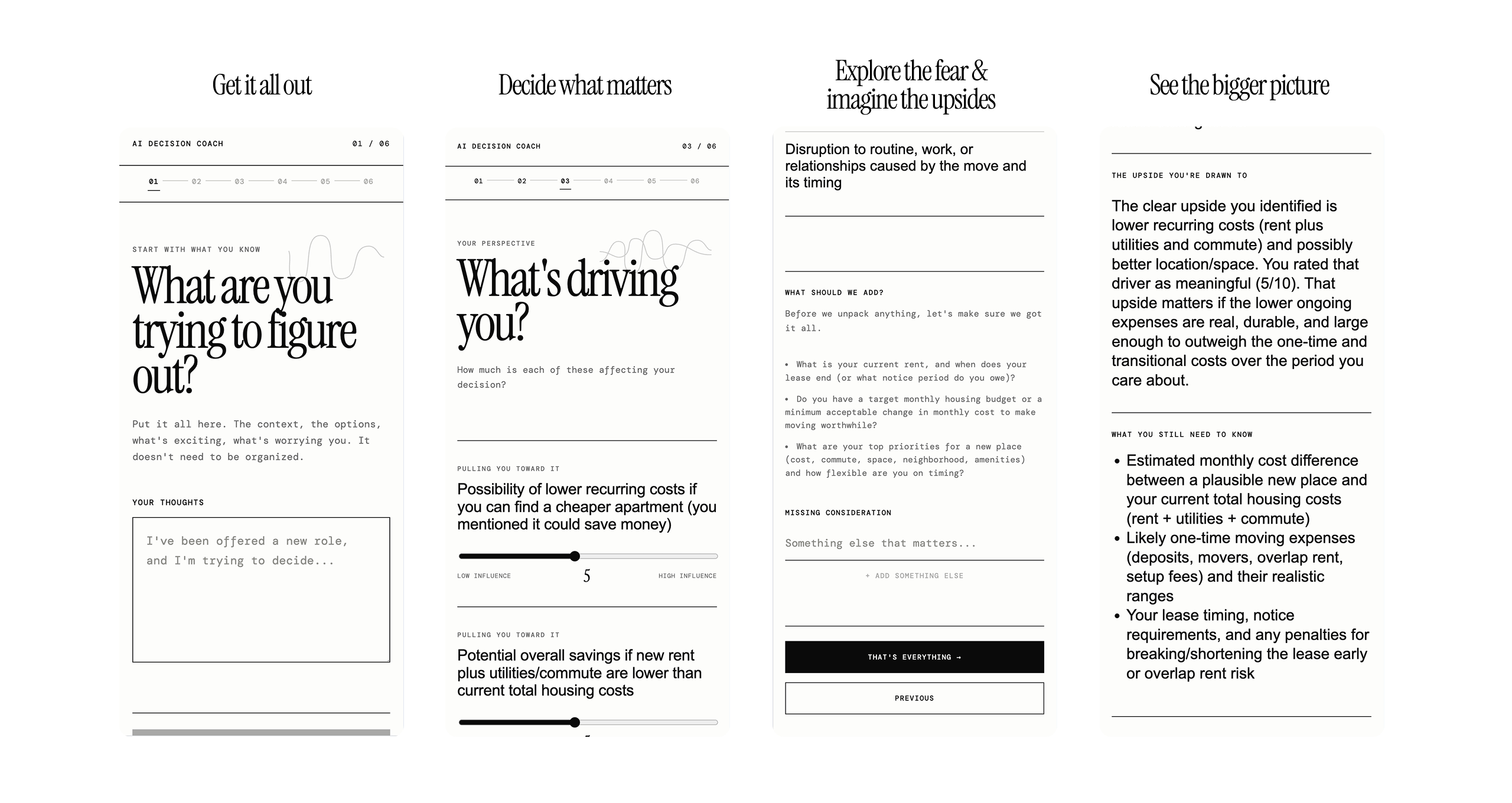
HOW IT WORKS
The experience starts with an open-ended brain dump. AI then identifies the forces pulling the user in different directions and helps them work through fears, potential upside, and unresolved trade-offs.
Human-controlled weighting and structured prompts keep the experience from becoming an AI recommendation engine.
PROCESS
This project gave me a place to experiment with AI as part of the product experience itself, rather than simply using AI behind the scenes to build faster.
AI interaction design
Designed when AI should interpret, reflect, ask questions, and deliberately not provide an answer.
Human + AI roles
Created a system where AI handles synthesis and pattern recognition while users retain control over weighting, judgment, and the final decision.
AI-assisted development
Used ChatGPT and Codex to move from product concept and UX flows into a functional React application connected to the OpenAI API.
Shipping
Worked through implementation, API integration, debugging, Git-based development, QA, and deployment of a live experience.
WHAT CHANGED FOR ME
Building the Decision Coach pushed me to think differently about designing for AI.
Traditional product flows are largely deterministic: the designer can anticipate what happens after an interaction. Introducing an LLM means designing a system of behavior rather than a fixed sequence of outputs.
The most important design decision became not what the AI could do, but what it should do. Giving the model less authority ultimately made the experience more useful: AI provides structure and perspective while the human remains responsible for the decision.
NEXT STEPS
The core experience is working. Next, I want to explore how it can become a more adaptive AI product.
Conversation + memory
Explore a more conversational experience that can retain context as someone works through a decision over time.
More adaptive reflection
Experiment with AI-generated follow-up questions that respond to what the user is actually struggling with rather than relying entirely on a predetermined sequence.
Evaluation + guardrails
Develop ways to evaluate the quality and consistency of AI responses and further define boundaries around advice, bias, and overly prescriptive outputs.
Real-user testing
Put the experience in front of users with real decisions and learn where AI reflection genuinely creates clarity — and where human-designed structure works better.